Apoe4 - the Ancestral allele
APOE4 (A4) carriers—especially homozygotes (those with two copies of the APOE4 allele, A4/4)—are considered to have a genetic predisposition to a shortened lifespan, cardiovascular disease, and, most notably, Alzheimer’s disease (with up to 12x the risk). Because of this, A4 has been dubbed the “Alzheimer’s gene,” with some even going so far as to call it the “death gene.” These dire labels have many people afraid to learn their A4 status, and by avoiding it, they may miss important windows of opportunity to mitigate risk.
I would argue that referring to A4 as the Alzheimer’s or “death” gene is egregiously inappropriate for several reasons:
- A4 alone is not the cause of Alzheimer’s. Many people with no copies of A4 still develop the disease, while not everyone with one—or even two—copies does.
- The saying, “Genetics load the gun, and environment pulls the trigger,” underscores that more is at play than genes alone. In some cultures and environments, A4 carriers actually fare better in terms of cognition and longevity than non-carriers.
- The A4/4 profile was prominent—even dominant—through much of human evolution, including periods when human lifespan was increasing.
Because A4/4 was so prevalent throughout our evolutionary history, I prefer labeling A4—if we feel the need to label it at all—as the “ancestral gene” or allele..
Might we have tunnel vision?
If A4/4 was once advantageous, why is it now viewed as the genetic equivalent of rolling snake eyes—the worst possible outcome? To me, this shift reflects a contextual issue more than an inherent flaw. The contrast between A4’s past utility and its current perception points to a mismatch with modern living.
Humans evolved in environments that radically differ from those we currently experience; thus, traits that were once advantageous may now be “mismatched” and disease-causing. At the genetic level, this hypothesis predicts that loci with a history of selection will exhibit “genotype by environment” (GxE) interactions, with different health effects in “ancestral” versus “modern” environments. Applying an evolutionary mismatch framework to understand disease susceptibility
Given Alzheimer’s association with modern chronic inflammatory conditions, it would be prudent to look both forward—for novel interventions—and backward—for time-honored insights.
Relatively speaking, might A4 be a bit of a scapegoat--taking the blame for consequences of unhealthy and toxic modern living?
Meaningful A4 risk mitigation likely comes from bridging the modern and the ancestral. The current doomsday narrative surrounding A4 generates more fear than useful action. If people better understood the evolutionary context and its connection to modern chronic disease, they might feel more empowered to be proactive.
As someone who is A4/4, I still live in a modern, high-tech world—but I also stay grounded, as much as possible, in the natural one. One potential “perk” of being A4/4 is a strong intuitive pull toward what supports my health: time outdoors, exposure to natural microbes, alignment with natural cycles (light and seasons), regular physical activity, and nutrient-dense whole foods grown as nature intended. While I may feel this more acutely, I believe these inputs benefit everyone, regardless of A4 status.
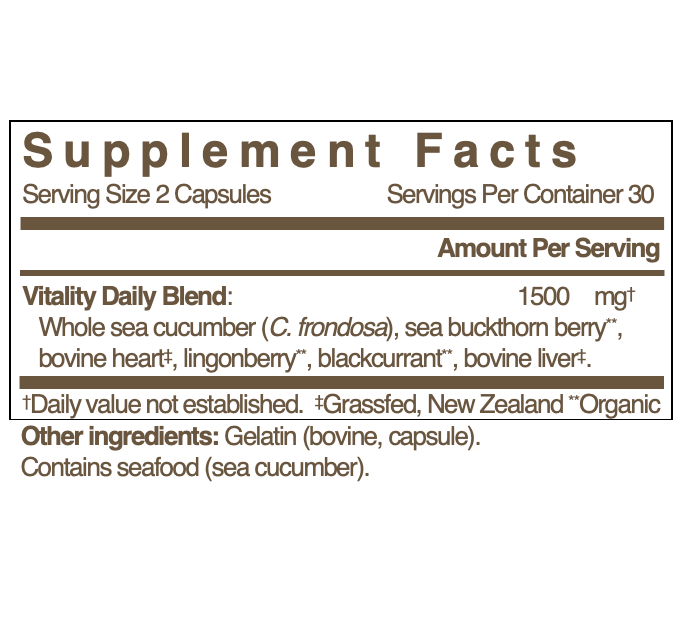
As Co-Founder of Way Back, I formulated Vitality Daily with my A4/4 status in mind. It’s something that truly resonates with my body—I not only benefit from it, I look forward to taking it. By replenishing nutrient-dense, whole-food elements that were once commonly consumed but are now lacking, I aim to help bridge the gap between modern living and our ancestral roots.
Raichlen D, Alexander G. Exercise; APOE genotype, and the evolution of the human lifespan; Trends in Neurosciences, 2014; 37, 247-255