Not All Collagen Is the Same
Collagen is collagen...right?
Not exactly.
Not all collagen comes from the same source.
The source of collagen can dramatically influence how it's processed and what ends up in the final product.
Land-animal collagen (bovine, porcine, and chicken) is tightly bound within dense, highly cross-linked connective tissue. Extracting collagen typically requires prolonged heat and chemical processing to isolate collagen peptides.
Marine collagen generally comes from fish skin, scales, and bones. Because fish collagen has a lower denaturation (melting) temperature and less heavily cross-linked connective tissue, it can often be extracted under less intensive conditions than land-animal collagen.
Not all marine collagen is the same.
Marine collagen is often praised for its smaller peptides and efficient absorption—but there's more to consider.
Most marine collagen supplements isolate collagen peptides from fish skin, scales, and bones, removing much of the tissue's original biological complexity in the process.

Sea cucumber is fundamentally different.
The body wall of Cucumaria frondosa is unlike any other collagen source.
It contains approximately 70% collagen (dry weight), but even more importantly, that collagen exists within an extraordinary extracellular matrix (ECM)—a highly specialized biological scaffold that enables the animal's remarkable tissue flexibility, remodeling, and regenerative abilities.
The same biological architecture that allows a sea cucumber to rapidly shift between rigid and flexible states makes the tissue more pliable and the collagen easier to access without the need for aggressive isolation.
What this means for your body
Traditional land and fish collagen products primarily deliver isolated collagen peptides.
Sea cucumber can provide collagen peptides within much of their natural biological context.
Rather than supplying collagen alone, the body wall also contains naturally occurring extracellular matrix components, including:
- Glycosaminoglycans (GAGs)
- Native chondroitin sulfate
- Structural proteins
- Trace minerals
- Additional naturally occurring bioactive compounds
These molecules naturally exist alongside collagen within the original tissue.
Instead of delivering only the building blocks, you're providing collagen together with many of its native companion molecules.
Sea cucumber, has attracted scientific interest for its remarkable regenerative abilities. Rich in marine collagen, sulfated GAGs, peptides, and other specialized ECM complements, sea cucumber is well equipped to support tissue repair, cellular signaling, and connective tissue resilience. Its naturally occurring compounds have been studied for their potential roles in supporting skin, joints, cartilage, and vascular tissues.
Sometimes the difference isn't just the source of the collagen, but the biology surrounding it.
Comparison Charts
Collagen Sources
| Feature | Land Animal Collagen | Fish Marine Collagen | Sea Cucumber (C. frondosa) |
|---|---|---|---|
| Source | Bovine, porcine, chicken | Skin, scales, bones | Body wall |
| Primary nutritional focus | Collagen peptides | Collagen peptides | Collagen peptides within an ECM-rich tissue |
Isolate vs. Matrix-Centric
| Standard Collagen Isolate | Matrix-Centric Sea Cucumber |
|---|---|
| Purified collagen peptides | Collagen peptides plus naturally occurring companion bioactives |
| Protein isolated from tissue | Native tissue matrix retained to a greater extent* |
| Primarily collagen | Naturally occurring matrix of collagen, GAGs, native chondroitin sulfate, minerals, and additional bioactive compounds |
*Compared with conventional collagen isolates.
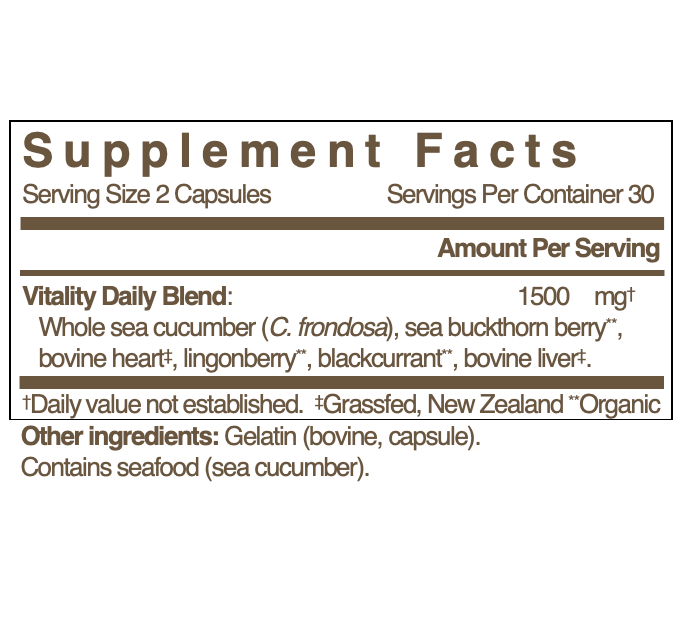
Vitality Daily delivers matrix-centric wild sea cucumber nutrition—collagen peptides together with naturally occurring extracellular matrix molecules.
Wild, sustainably harvested Cucumaria frondosa from Canada is the #1 ingredient in Vitality Daily.
Nature rarely works in isolation. Why should your nutrition?
Vitality Daily. Matrix-centric nutrition. Collagen and beyond.
Explore More: Collagen is not a solo act