How We Set Out to Create the Ultimate Real Food Supplement
She said, "Let's do it."
My friend and colleague, Erika, asked me a simple question:
"If you could design the ultimate supplement, what would it be?"
I've asked myself that same question many times.
To me, the ultimate supplement would be:
- One that supports us throughout our lifespan because it supported us throughout our history.
- One that helps prime the body's metabolic and physiological processes, systems, and pathways.
- One sourced from what our bodies instinctively understand—real food.
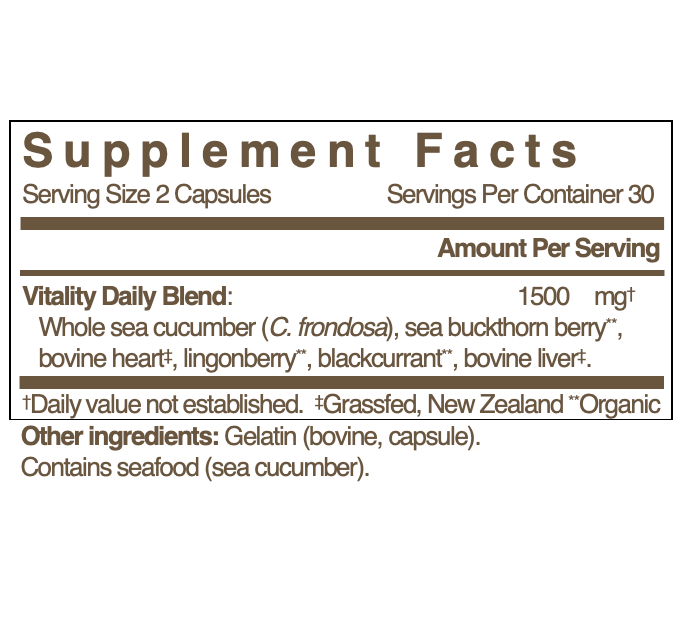
That conversation became the foundation for what would eventually become Vitality Daily.
A Personal and Professional Journey
How I came to think about supplements this way is both personal and professional.
On a personal level—whether it's simply my nature or influenced by having two copies of the APOE4 allele—I seem to have a heightened awareness of what isn't in my body's best interest. The APOE4 variant is associated with an increased risk of late-onset Alzheimer's disease, particularly in people with two copies. It has also been linked to a more pronounced inflammatory response.
You could say that I'm more reactive than most folks. For better or worse, I've often felt like the proverbial canary in the coal mine.
I appreciate the cutting-edge science and design behind many modern supplements. But the reliance on isolated synthetic supplements simply didn't resonate with me. Instead, I began asking different questions.
Beyond searching for natural alternatives, I wanted to understand how they worked. What were their intrinsic mechanisms of action? How did they support the body's own ability to build, maintain, and regulate itself?
That approach made sense—not only to my body, but to my way of thinking.
The Snowball Supplement Effect
Despite incredible advances in nutritional science, why do so many people still find themselves taking more and more supplements while feeling no better—or sometimes worse?
I saw this repeatedly in my professional work.
One isolated supplement often led to another, and then another. Before long, people had a cabinet full of bottles, many of which they couldn't remember why they started taking in the first place.
I came to call it the Snowball Supplement Effect.
Asking Better Questions
When a study suggests that low levels of "X" are associated with poor health, it's worth asking a few additional questions.
- Is the story really only about "X"?
- Why is "X" low in the first place?
- Does supplementing "X" address the underlying cause?
- Could relying on supplemental "X" reduce the body's own production or regulation?
- Is it bypassing or overriding an important biological pathway?
- Does "X" work in balance with other nutrients that are being overlooked?
- If too little is harmful, could too much—or delivering it outside its natural food matrix—also have unintended consequences?
Similar questions could be asked when a study suggests that high levels of "Y" are associated with poor health. These type of questions shifted my perspective from simply replacing isolated compounds to supporting the body's innate ability to function as it was designed.
A More Complete Approach

If you're looking for a more balanced and sustainable way to supplement—whether to replace or complement your current routine—Erika and I believe there's a better approach.
Instead of chasing a single letter of the alphabet, we looked to the whole alphabet, delivered as nature intended.
Not just isolated nutrients, but the complete food matrix that works together to nourish the body.
Our goal wasn't simply to increase nutrient levels. It was to provide the raw materials your body recognizes and uses to support resilience, vitality, and long-term health.
Because sometimes the smartest innovation isn't creating something new.
It's rediscovering what worked all along.
Food for thought—and food for real, lasting results.