Collagen is not a solo act

Collagen is the most abundant protein within the Extracellular Matrix (ECM)—a complex network that provides structural and biochemical support to surrounding cells. Far from being merely structural, the ECM plays an active role in tissue resilience, repair, and cellular communication. Collagen’s role within the ECM is fundamental to the integrity and function of living tissues.
Inside the ECM, collagen works in concert with other critical biomolecules, including sulfated polysaccharides known as glycosaminoglycans (GAGs). Examples of GAGs include heparin, chondroitin sulfate, and hyaluronic acid. While collagen provides the structural scaffolding, GAGs help regulate hydration, cellular signaling, and ECM dynamics. Together, their interplay influences everything from connective tissue strength and organ integrity to cellular behavior and recovery.

This relationship is especially important for the endothelial lining of blood vessels, where a healthy ECM helps maintain vascular resilience, elasticity, barrier function, and proper blood flow. Supporting the ECM means supporting the structural environment that helps blood vessels remain strong, adaptable, and responsive.
Whole food sources of collagen include meat, fish, and eggs. Animal-based foods are also primary dietary sources of GAGs, with certain marine species—including sea cucumber, starfish, and sea urchin—containing structurally diverse compounds with uniquely supportive properties.

Sea cucumber, in particular, has attracted scientific interest for its remarkable regenerative abilities. Rich in marine collagen, sulfated GAGs, peptides, and other specialized ECM complements, sea cucumber is well equipped to support tissue repair, cellular signaling, and connective tissue resilience. Its naturally occurring compounds have been studied for their potential roles in supporting skin, joints, cartilage, and vascular tissues.
Other cofactors essential for collagen formation and maintenance include:
• Vitamin C
• Zinc
• Copper
• Amino acids (especially glycine and proline)
• Omega-3 fatty acids
Nutrient-dense whole food sources of these nutrients include fruits (especially citrus and berries), seafood, bone broth, and animal products such as organ meats.
The importance of collagen support factors from real food cannot be overstated. Collagen's activation, production, and maintenance are dependent on biomolecules found in whole foods--improving bioactivity and bioavailability for healthier skin, joints, bones, cartilage, tendons, and blood vessels.
Consuming a balanced, nutrient-rich diet helps ensure the body has the necessary building blocks and cofactors for optimal collagen production, ECM maintenance, and connective tissue resilience.


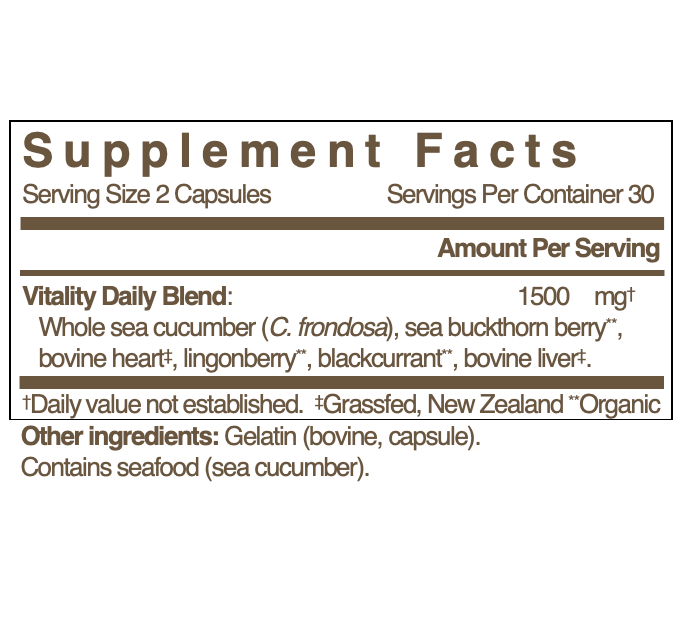
Vitality Daily—a nutrient-dense, whole food-based nutraceutical—delivers full-spectrum Extracellular Matrix support in the convenience of a capsule, with wild sea cucumber, organic sea buckthorn berry, grass-fed beef heart and liver, organic blackcurrant, and lingonberry.
Shop